
Best gutter types for Mornington Peninsula homes 2026
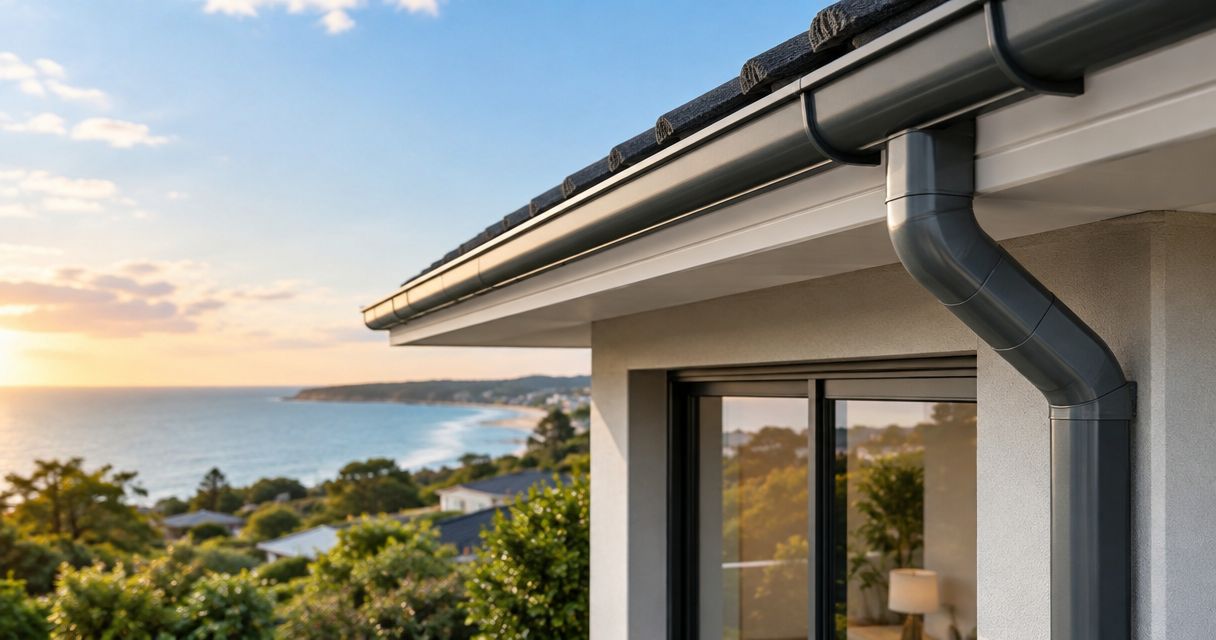
Best overall starting point: quad gutters for a conventional external-gutter replacement. Best for an open, curved profile: half-round gutters. Best for decorative roof edges: ogee gutters. Best for concealed architectural drainage: box gutters, only where the roof design calls for them. This 2026 guide explains how to choose for your Mornington Peninsula home without confusing appearance with drainage performance.
TL;DR
- The best gutter types Mornington Peninsula homeowners choose must suit roof catchment, overflow paths and coastal exposure.
- Quad gutters are the default shortlist choice for a conventional external-gutter replacement, subject to drainage assessment.
- Half-round suits an open profile; ogee suits decorative roof edges; box gutters require purpose-designed drainage.
- Reroofing Melbourne provides residential guttering, re-roofing and cladding services across the Mornington Peninsula.
Why this matters
A gutter profile describes its shape, not its suitability for your house. Roof area, gutter dimensions, downpipe positions and overflow provisions determine how the drainage system works together. A familiar-looking replacement can still repeat an existing drainage problem.
Coastal exposure adds another decision. Salt exposure affects material and coating selection, so a profile recommendation alone is incomplete. Ask for the manufacturer's suitability requirements for your property's actual setting, rather than accepting a general claim that a gutter is suitable near the beach.
Reroofing Melbourne provides residential guttering, re-roofing and cladding services across the Mornington Peninsula. Choose the drainage arrangement first, then confirm the profile, material and finish.
What makes the best gutter types for Peninsula homes?
Use these criteria to assess any gutter recommendation in 2026:
- Drainage capacity: Match the complete system to the roof catchment and local design rainfall, not just the width of the existing gutter.
- Safe overflow: Establish where water escapes if an outlet blocks or the system is overwhelmed. Overflow must not be directed into the building.
- Coastal suitability: Check the specified material, coating, fixings and maintenance requirements against the exposure at your property.
- Cleaning access: Consider nearby trees, roof valleys and whether the gutter can be inspected and cleared safely.
- Roof-edge fit: Check the fascia, roof-sheet or tile overhang, available fall and downpipe connections.
- Appearance: Select a shape that suits the house after the drainage requirements are settled.
Ask for 2 separate assessments: drainage suitability and coastal suitability. A profile can suit the roof edge while the proposed material remains unsuitable for the exposure.
Gutter types at a glance
This 2026 comparison ranks profiles by their role in a residential gutter replacement. It does not treat every profile as an interchangeable upgrade.
| Gutter type | Best for | Standout feature | Key limitation |
|---|---|---|---|
| Quad gutters | Conventional external-gutter replacements | A rounded front on an external eaves gutter | Profile name alone does not establish capacity or overflow performance |
| Half-round gutters | Homeowners wanting an open, curved profile | A semicircular channel | Requires compatible brackets and a roof-edge arrangement that suits the shape |
| Ogee gutters | Decorative or traditionally detailed roof edges | A shaped front face | Appearance does not establish drainage suitability |
| Box gutters | Roofs designed around concealed drainage | An internal channel integrated with the roof design | Overflow and waterproofing details need particular attention |
Quad is the default shortlist choice here because this guide starts with a conventional external-gutter replacement. That is a decision rule, not a claim that quad outperforms every other shape. An existing box-gutter roof needs a different assessment.
1. Quad gutters: best for conventional replacements
Quad gutters have a rounded front and sit along the external roof edge. They belong on your shortlist when you want to replace an external gutter without making the gutter itself a prominent design feature.
Start by checking why the existing system needs replacement. Rust, repeated overflow and water running behind the gutter are different problems; copying the old arrangement does not resolve all of them.
Quad gutter pros:
- Suits a straightforward external-eaves arrangement where the dimensions and supports are appropriate.
- Gives the roof edge a familiar rounded finish.
- Keeps the drainage channel outside the building envelope.
Quad gutter cons:
- Different quad profiles have different dimensions; the name is not a capacity rating.
- Reusing poorly positioned outlets preserves a drainage weakness.
- The front and back heights still need an appropriate overflow arrangement.
Best for: Homeowners replacing conventional external gutters while retaining a similar roof-edge appearance.
For your 2026 quote, ask whether the proposed quad gutter changes the channel size, outlet arrangement or overflow detail. A clear answer is more useful than a statement that the replacement is simply larger.
Verdict: Buy if the drainage assessment supports an external quad system; skip a like-for-like replacement that leaves the original problem unresolved.
2. Half-round gutters: best for an open, curved profile
Half-round gutters use a semicircular channel. Their curved shape creates a distinct roof-edge finish, so they suit homeowners who want the gutter profile to be a visible part of the house.
The shape does not remove the need for cleaning. Leaves can still collect at outlets, and nearby vegetation still matters. Check how the gutter will sit beneath the roof edge before choosing it for appearance alone.
Half-round gutter pros:
- Provides a simple, visibly curved profile.
- Has an open channel that can be inspected from a suitable safe access position.
- Offers a different appearance from shaped-front eaves gutters.
Half-round gutter cons:
- Requires brackets and connections suited to the selected system.
- Does not make the roof drainage self-cleaning or maintenance-free.
- Must be sized for the roof rather than selected solely by its diameter or appearance.
Best for: Homeowners who want an open, rounded gutter and accept the associated support and installation requirements.
Ask the installer to explain the bracket arrangement, roof overhang and outlet connection together. Treat these as parts of the same system, not finishing details to resolve after choosing the gutter.
Verdict: Buy for the curved profile when the installation details work; skip if the main selling point is a promise of no cleaning.
3. Ogee gutters: best for decorative roof edges
Ogee gutters have a shaped front face that gives the eaves a more decorative finish. They deserve consideration when your home's roof edge has traditional detailing or you want to retain an established architectural character.
Choose the actual profile, not just the word ogee. Check its dimensions and how it meets the fascia, corners and outlets. A decorative front does not tell you how much roof area the system can drain.
Ogee gutter pros:
- Adds definition to a decorative roof edge.
- Can support a consistent appearance when replacing a similarly shaped gutter.
- Keeps an external gutter arrangement where that suits the roof.
Ogee gutter cons:
- The shaped face is an appearance feature, not evidence of higher capacity.
- Matching the old look does not establish that the old drainage layout was adequate.
- Overflow provisions need checking independently of the front profile.
Best for: Homeowners who want decorative eaves detailing without changing to concealed drainage.
Before approving the profile, compare 3 details: channel dimensions, outlet positions and overflow provisions. This keeps the discussion focused on how the gutter works as well as how it looks.
Verdict: Buy when the decorative finish suits the house and the drainage design checks out; skip if appearance is the only justification.
4. Box gutters: best for roofs designed for concealed drainage
Box gutters are internal drainage channels, commonly used where roof planes meet or where the design conceals drainage behind a parapet. They are not simply another external gutter shape to swap onto any house.
Because the channel sits within the roof arrangement, leakage or uncontrolled overflow can affect the building interior. The assessment needs to cover the channel, outlets, sumps where required, overflow provisions and adjoining waterproofing details.
Box gutter pros:
- Serves roof layouts that need an internal drainage channel.
- Allows drainage to sit behind a parapet or within the roof design.
- Can receive runoff from adjoining roof planes when properly designed.
Box gutter cons:
- Requires particular care with overflow and waterproofing details.
- Concealed sections can make developing problems less obvious from ground level.
- Replacement can involve adjoining roof components, not just the gutter channel.
Best for: Homes whose roof geometry already requires purpose-designed internal drainage.
For a 2026 box-gutter replacement, request an explanation of the emergency overflow path. If that explanation stops at keeping the outlet clean, the drainage discussion is unfinished.
Verdict: Hold until the drainage and overflow details are assessed; skip box gutters as a purely cosmetic substitute for an external system.
Shape and material are different decisions
Quad, half-round and ogee describe profiles. They do not identify a particular metal, coating or coastal exposure rating. Box describes a drainage arrangement as well as a channel form.
That distinction matters around the Mornington Peninsula. A sheltered property and a directly exposed coastal property should not receive identical material advice simply because they share a suburb.
Use this order when reviewing a proposal:
- Roof catchment: Establish where the water comes from.
- Drainage layout: Check channels, outlets, downpipes and overflow paths.
- Material suitability: Confirm exposure requirements and compatibility with adjoining materials.
- Maintenance access: Establish how inspection and cleaning will happen safely.
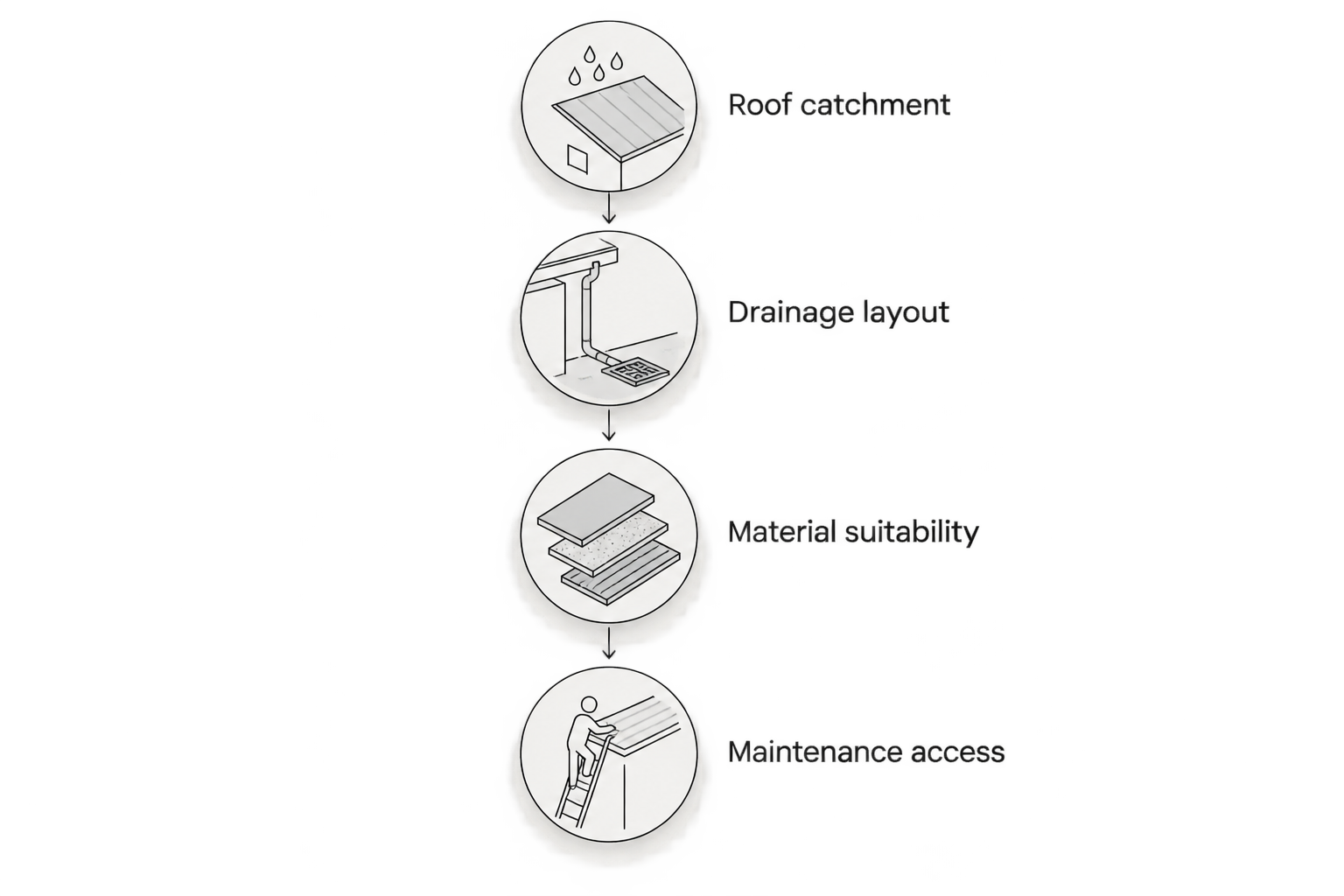
Choose the drainage arrangement before settling on the gutter finish.
Ask the installer to identify the proposed material and finish in writing, including relevant manufacturer requirements. Check compatibility with roof runoff, fasteners and adjoining metals. Do not substitute a general coastal claim for a specific product suitability check.
What your gutter replacement scope should explain
Keep 1 written scope that records the complete arrangement. It should explain what changes, what stays and which existing components need attention.
- Existing condition: Identify damaged fascia, deteriorated supports or evidence of water getting behind the gutter.
- Proposed system: Name the profile, material, finish and support arrangement.
- Water discharge: Explain outlet and downpipe locations, including any retained components.
- Overflow: State where excess water is directed away from the building interior.
- Maintenance: Identify cleaning access and any manufacturer maintenance conditions.
For your 2026 project, ask whether the assessment includes the downstream drainage connection. Replacing the roof-edge channel does not by itself establish that the rest of the drainage system works.
Stay on the ground when checking symptoms. Photograph visible staining, sagging or overflow from a safe position and record where it happens during rain. Leave roof access and close inspection to someone equipped for the work.
How the gutter types were ranked
This guide prioritises drainage suitability, safe overflow, coastal material selection, maintenance access and roof-edge fit. Quad leads for conventional replacements; half-round and ogee serve different appearance preferences; box gutters serve a different roof arrangement.
These are selection criteria, not product test results. Reroofing Melbourne's residential service scope makes the replacement decision the focus here, rather than a ranking of manufacturers or coatings.
Which gutter type should you choose?
Start with quad for a conventional external-gutter replacement, then let the roof assessment confirm or reject that choice. Choose half-round for its open curved profile, or ogee for a decorative roof edge, only after capacity and overflow are resolved.
If your home has box gutters, start with the roof geometry and existing drainage details instead. Do not apply an external-gutter recommendation to a concealed internal channel.
Reroofing Melbourne is best suited to Mornington Peninsula homeowners seeking residential guttering services alongside re-roofing or cladding work. Ask for advice that connects the gutter choice to the rest of your roof.
FAQ
What's the best gutter type for a Mornington Peninsula home?
Quad is the default shortlist choice for a conventional external-gutter replacement, subject to a drainage assessment. Half-round suits a curved appearance, ogee suits decorative eaves, and box gutters suit roofs designed around internal drainage.
Are half-round gutters better than quad gutters?
Half-round gutters are not automatically better than quad gutters. Compare the actual dimensions, roof catchment, support arrangement, outlets and overflow provisions rather than choosing on shape alone.
Which gutters should I choose near the beach?
Choose a gutter system whose specified material, coating and fixings suit the property's coastal exposure. Check the manufacturer's requirements for the actual setting; a profile name does not establish salt-exposure suitability.
Will bigger gutters stop my roof overflowing?
Bigger gutters alone do not guarantee that overflow will stop. Blocked or poorly positioned outlets, downpipe restrictions and the wider drainage layout also need assessment.
Are box gutters a good replacement for external gutters?
Box gutters are not a straightforward replacement for external eaves gutters. They form part of the roof design and require suitable drainage, waterproofing and emergency overflow details.
Do half-round gutters clean themselves?
Half-round gutters still need inspection and cleaning. Leaves and debris can collect at outlets regardless of the channel shape, so safe maintenance access remains part of the decision.
What should I ask a gutter installer before agreeing to the work?
Ask for the profile, material, drainage layout and overflow provisions in writing. Reroofing Melbourne provides residential guttering services across the Mornington Peninsula; discuss how the proposed work connects with the existing roof and downpipes.
One last thing
Ask where the water goes when an outlet blocks. That question reveals more about a gutter proposal than the profile name. A clear overflow explanation belongs in your 2026 replacement decision, not after the next storm exposes a problem.