Best colorbond roof colours for coastal homes 2026
Best overall for a light coastal palette: Surfmist; best for a neutral grey exterior: Shale Grey; best for warm brick and timber: Dune. This 2026 guide compares the best COLORBOND roof colours for coastal homes by appearance, heat response and how they work with the rest of your house.
TL;DR
- Surfmist leads the best colorbond roof colours for coastal homes shortlist when you want a light coastal palette.
- Shale Grey suits neutral exteriors; Dune works with warmer brick, render and timber.
- Roof colour does not establish coastal suitability: check the roofing product against the site's exposure.
- Reroofing Melbourne provides residential re-roofing services for Mornington Peninsula homeowners planning a roof replacement.
Why this matters
A roof colour has to work with the parts of your home you are keeping. Existing brick, window frames, gutters and paving give you a better starting point than an isolated colour swatch.
For a coastal roof replacement in 2026, separate the appearance decision from the material decision. A shade that looks right beside the beach does not, by itself, establish whether a roofing product suits salt-air exposure.
Reroofing Melbourne provides residential roof replacement, guttering and cladding across the Mornington Peninsula. Plan those visible surfaces together, even when the roof is the only part being replaced now.
What makes the best coastal roof colour?
Use these criteria before choosing between individual shades. A good colour fits your house; a suitable roofing specification fits your site.
- Colour compatibility: Match the undertones in fixed materials, especially brick, stone and window frames. Warm and cool greys are not interchangeable.
- Coastal suitability: Check the proposed roofing product, fixings and installation requirements against the property's exposure. Colour alone is not a corrosion specification.
- Heat response: Lighter surfaces generally absorb less solar energy than darker surfaces. Roof colour is only part of the home's thermal performance.
- Street presence: Consider how much roof you see from the street. A broad, steep roof makes a stronger colour statement than a roof largely hidden behind a parapet.
- Upkeep expectations: Consider visible leaf litter, salt deposits and streaking. No colour removes the need for appropriate inspection and maintenance.
Avoid choosing a roof first and treating every other surface as a problem to solve later. If the brickwork is staying, it deserves more weight than a front-door colour you can change.
Coastal roof colours at a glance: 2026 shortlist
These rankings describe design fit, not differences in corrosion resistance. The same colour name is not a substitute for checking the roofing material specification.
| Rank and colour | Best for | Standout feature | Key limitation |
|---|---|---|---|
| 1. Surfmist | Light coastal palettes | A pale roof that keeps the overall exterior light | Needs checking beside creamy whites |
| 2. Shale Grey | Neutral grey exteriors | A restrained alternative to a dark grey roof | Can make a cool exterior feel colder |
| 3. Dune | Warm brick and timber | A warm neutral connection between roof and walls | Less suited to deliberately cool palettes |
| 4. Windspray | Muted blue-grey schemes | A more noticeable cool-grey colour direction | Undertones need careful sample checking |
| 5. Wallaby | Earthy, landscape-led homes | A deeper, warm grey-brown appearance | Adds visual weight to a large roof |
| 6. Monument | Strong architectural contrast | A dark frame against lighter walls | Not the default choice for a low-heat palette |
1. Surfmist: best coastal roof colour for light exteriors
Surfmist is the starting point when you want the roof to sit quietly above white, off-white or pale walls. Its light appearance supports a coastal scheme without relying on blue accents or beach-themed details.
Surfmist is the best default for homeowners seeking a light coastal roof, provided the sample works with the existing exterior. Place it beside your actual wall colour: a roof sample and a creamy render sample can look quite different together than they do separately.
Surfmist pros:
- Keeps the roof within a light exterior palette.
- Offers an alternative to a strong charcoal roof outline.
- Supports a lighter-coloured approach to solar heat absorption.
Surfmist cons:
- Pale finishes can make surface deposits and streaks noticeable.
- The undertone needs checking beside warm whites and cream brick.
Best for: White weatherboards, pale render and homeowners who want the roof to feel visually light.
Do not assume every white gutter or fascia will match. Compare those samples together before approving the combination. Verdict: Buy for a light coastal palette after checking the whites together.
2. Shale Grey: best coastal roof colour for neutral grey homes
Shale Grey gives you a grey roof without moving straight to charcoal. It suits an exterior where the roof needs some definition but should not become the strongest feature.
Start here if your house already has grey paving, pale masonry or restrained neutral cladding. Check whether those existing surfaces lean warm or cool before committing; the word grey covers a wide range of appearances.
Shale Grey pros:
- Provides more roof definition than a very pale finish.
- Works as a starting point for grey-based exterior schemes.
- Leaves room for a stronger front door or landscape feature.
Shale Grey cons:
- Can reinforce a cold appearance beside cool walls and paving.
- Does not automatically match existing grey gutters or metalwork.
Best for: Homeowners wanting a neutral grey roof rather than a bright white or dark charcoal one.
Take the sample outside with your window-frame and wall samples. Verdict: Buy for a neutral exterior when the grey undertones agree.
3. Dune: best coastal roof colour for warm brick and timber
Dune belongs on the shortlist when your home has beige masonry, warm render or natural timber. It offers a warmer direction than a distinctly cool grey.
This is useful when the roof is changing but the walls are staying. Instead of forcing warm brick into a cool scheme, use the roof to connect the existing materials.
Dune pros:
- Provides a warm neutral option for coastal homes.
- Gives beige and earth-toned materials a useful comparison point.
- Supports a softer overall scheme than a high-contrast dark roof.
Dune cons:
- Can feel out of place beside deliberately blue-grey finishes.
- Similar warm tones still need checking rather than matching by name.
Best for: Homes retaining warm brick, cream-toned render or timber details.
Look at the mortar as well as the brick. Mortar occupies enough of the wall surface to influence how the whole combination reads. Verdict: Buy when the fixed exterior materials lean warm.
4. Windspray: best coastal roof colour for blue-grey palettes
Windspray suits a homeowner who wants a cooler roof with more colour character than a straightforward pale neutral. Its grey appearance makes it a useful sample to compare against muted blue-grey exterior finishes.
Do not choose it simply because the house is near the water. The better test is whether the roof belongs with the walls, windows and gutters when you view them together outdoors.
Windspray pros:
- Offers a distinct cool-grey direction.
- Provides an alternative to both pale white and deep charcoal.
- Gives muted blue-grey schemes another roof option to assess.
Windspray cons:
- Its undertone needs checking beside warm brick and cream finishes.
- A small screen image is a poor basis for approving the combination.
Best for: Exteriors deliberately built around muted, cool colours.
Compare Windspray directly with Shale Grey rather than viewing them on separate days. Differences are easier to judge side by side. Verdict: Hold until an outdoor sample confirms the undertone.
5. Wallaby: best coastal roof colour for earthy exteriors
Wallaby takes the shortlist in a deeper, warmer direction. It deserves consideration when the exterior includes earthy masonry, timber or subdued landscape colours.
The roof's size matters here. A deep colour over a broad roof creates a more substantial visual cap than the same colour used on a narrow strip of guttering.
Wallaby pros:
- Gives warm exterior schemes a deeper roof option.
- Connects naturally with an earthy design direction.
- Provides contrast without choosing a cool charcoal palette.
Wallaby cons:
- Adds visual weight where a large roof dominates the elevation.
- Is not the first choice when minimising solar absorption is the priority.
Best for: Homes where earthy walls and timber details should guide the roof colour.
Stand back far enough to see the whole elevation before deciding. Verdict: Buy for an earthy scheme; skip if your aim is the lightest possible exterior.
6. Monument: best coastal roof colour for strong contrast
Monument is the dark option in this shortlist. It gives pale walls a strong roof outline and suits a deliberate high-contrast design.
That contrast comes with a trade-off: dark surfaces generally absorb more solar energy than light surfaces. Insulation, ventilation and the wider roof assembly still matter, but they do not make colour irrelevant.
Monument pros:
- Creates a clear contrast against pale walls.
- Gives dark windows and other dark details a roof-level counterpart.
- Makes the roof an intentional part of the exterior design.
Monument cons:
- Absorbs more solar energy than a lighter-coloured surface.
- Can dominate a low house with a broad, visible roof.
Best for: Homeowners deliberately choosing architectural contrast over a light roof palette.
Check the whole roof form, not just a sample held against one window. Verdict: Buy for intentional contrast; skip as an automatic coastal default.
Check the shortlist against your actual house
Use this sequence before approving a colour. You do not need a finished landscape plan, but you do need to know which exterior materials are staying.
- Keep fixed finishes. Set out the brick, render, window and paving colours that the roof must work with.
- Compare roof samples. Start with 2 physical samples representing genuinely different directions, such as Surfmist and Dune.
- Check outdoor light. Compare the samples in 2 daylight conditions: direct sun and open shade. Keep the wall sample beside them.
- Review the elevation. Check 3 viewing positions: the street, the driveway and the main outdoor living area.
- Confirm the specification. Ask the roofer to identify the proposed roofing product and its suitability for the site's exposure.
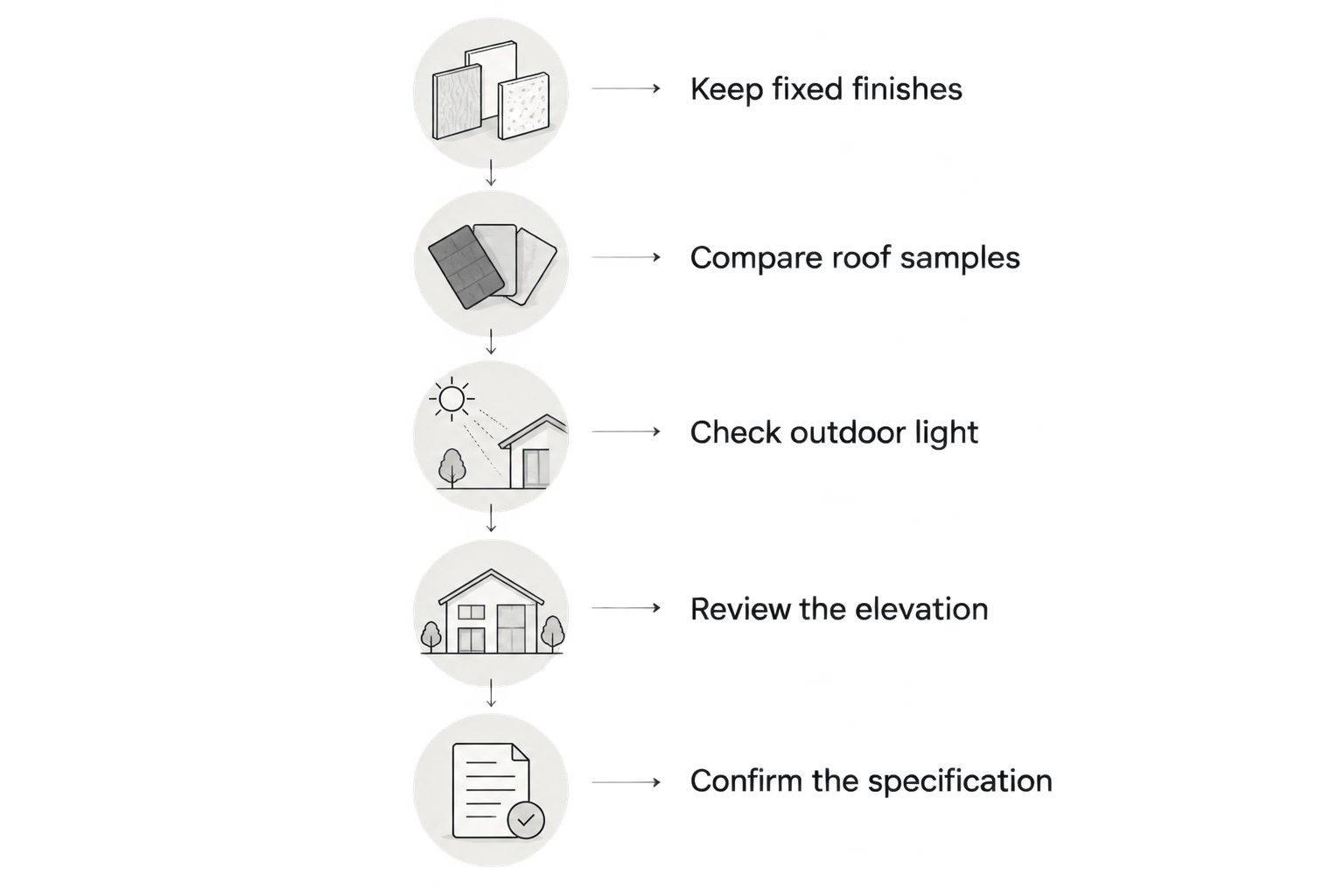
Check appearance and coastal suitability before approving the roof.
Photographs help you remember combinations, but do not use them as the final colour reference. Camera exposure and screen settings change what you see. Keep the physical samples available when the final roof and gutter selections are documented.
If the project also involves gutters or cladding, consider those surfaces together through the roofing, guttering and cladding services available for the home. Matching every surface is not compulsory; making the relationships deliberate is the useful part.
How these colours are ranked
The 2026 ranking puts an adaptable light coastal palette first, then separates the alternatives by use case: neutral grey, warm finishes, cool colour, earthy materials and strong contrast. It is a design shortlist, not a product durability league table.
Reroofing Melbourne's residential roof replacement service is relevant to homeowners planning the whole roof, rather than simply repainting a small exterior detail. Confirm the material specification separately from the colour selection. A colour recommendation cannot establish coastal suitability.
Which coastal roof colour should you choose?
For a 2026 roof replacement, start with Surfmist if you want a light exterior and have no strong reason to choose otherwise. Compare it with Dune when the walls lean warm, or Shale Grey when the house already follows a neutral grey scheme.
Choose Windspray for a deliberate cool-grey direction, Wallaby for earthy materials, and Monument for strong contrast. Those are different design jobs, not steps down a quality ladder.
Before signing off, ask for the roof colour, gutter colour and roofing product to be recorded separately. That keeps an appearance choice from being mistaken for a complete roofing specification.
FAQ
What's the best COLORBOND roof colour for a coastal home?
Surfmist is the best starting point for a light coastal palette. Compare a physical sample against the existing walls, windows and gutters before choosing it.
Is Surfmist better than Shale Grey for a beach house?
Surfmist is the better starting point for a pale exterior; Shale Grey suits a scheme that needs more grey definition. Neither colour name establishes whether the roofing product suits the property's coastal exposure.
Which roof colour works with cream brick?
Dune is a useful first sample for cream brick because it offers a warm neutral direction. Compare it against both the brick and mortar outdoors rather than choosing from a screen.
Is Monument a good roof colour near the coast?
Monument suits coastal homes where strong contrast is the design goal. Its dark colour absorbs more solar energy than a lighter surface, and coastal material suitability still needs a separate check.
Does a lighter roof colour prevent salt corrosion?
No, a lighter roof colour does not establish protection against salt corrosion. Check the roofing product, compatible components, installation requirements and maintenance guidance for the site's exposure.
Should gutters match the roof or the fascia?
Neither is compulsory: matching gutters to the roof creates one relationship, while matching them to the fascia creates another. Compare samples against the whole elevation before choosing.
Can Reroofing Melbourne replace a residential roof on the Mornington Peninsula?
Reroofing Melbourne provides residential roof replacement, guttering and cladding services across the Mornington Peninsula. Discuss the existing roof and the planned exterior finishes when enquiring about the project.
One last thing
Your roof sample is small. Your roof is not. Before approving the 2026 selection, place the sample beside the wall finish and step back to judge the relationship rather than inspecting the coating at arm's length.
Keep a record of the exact colour name and the separately specified roofing product. A clear selection is more useful than a photo labelled light grey, especially when gutters and cladding are being chosen at different stages.